
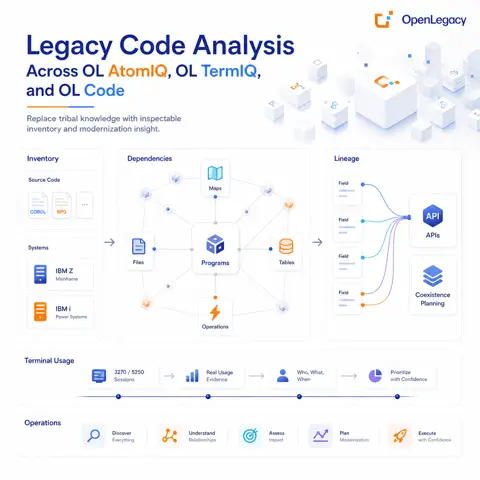
Legacy Code Analysis
Map programs, dependencies, data lineage, and real terminal usage so modernization decisions rest on evidence.
Challenges
- Modernization plans rely on tribal knowledge instead of an inspectable inventory of programs, maps, and data layouts.
- Teams cannot see field-level lineage or real 3270/5250 usage, so API and decoupling cuts miss hidden dependencies.
- IBM i and mainframe estates are analyzed with different tools, so RPG/DSPF and COBOL never share one graph.
Benefits
- Import host, CoreIQ/Hub, and offline sources into a shared dependency graph with domain and operation classification.
- Trace DB2 columns and file fields through COBOL host variables, and inspect maps and layouts with AI-assisted docs.
- Ground operations in real terminal usage via TermIQ recordings, then edit COBOL and RPG in a browser IDE.
Discover, visualize, and classify legacy estates (programs, dependencies, data lineage, screen flows, and real terminal usage), so modernization decisions are grounded in the actual code and how it is used.
Products
- OL AtomIQ: multi-source import, app viewer, source analysis, lineage, operations/domains, Graph Assistant & MCP
- OL TermIQ: terminal recordings, AI screen identification, and business operation definitions from real usage
- OL Code: browser explorer and editor for COBOL/RPG source on IBM Z and IBM i
What it covers
- Inventory import from host, CoreIQ/Hub, and offline sources
- Dependency graphs and domain/operation classification
- Source, map, table, and file layout inspection with AI enrichment
- Field-level data lineage and terminal journey analysis