
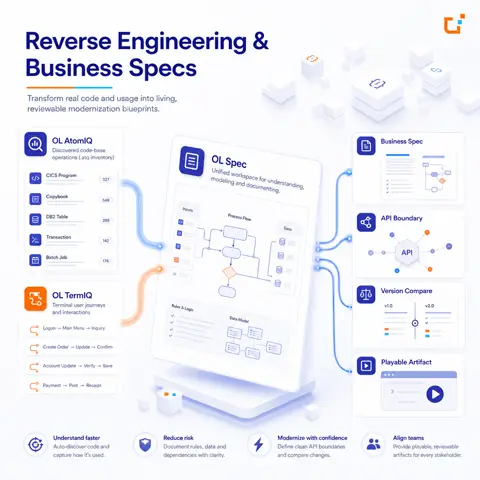
Reverse Engineering & Business Specs
Turn discovered operations and real terminal journeys into reviewable business specs and modernization blueprints.
Challenges
- Process documentation starts from a blank page instead of discovered operations and real terminal journeys.
- API boundaries and shared data models drift because they are not anchored in the same inventory the team already trusts.
- Stakeholders cannot play the specified process before committing to production builds.
Benefits
- Author living business specs from AtomIQ operations and TermIQ usage, refined in AI chat with versioned drafts.
- Plan API integration points and shared business models from the same discovered tree, then compare process versions.
- Generate runnable artifacts and play UI, service, or 3270 flows in-browser before codegen and scaffolding.
Turn discovered operations and terminal journeys into living business specifications (AI-authored process specs, shared models and roles, API boundary planning, versioning, and playable artifacts) anchored in AtomIQ and TermIQ inventory.
Products
- OL Spec (primary): import, AI spec chat, authoring, API integration points, models, versioning, players, plugins/codegen
- OL AtomIQ: operations and domain classification that seed specs
- OL TermIQ: operation definitions and Hub flow artifacts from real terminal usage
What it covers
- Reverse engineering from code-base operations and
.atqexports - Business process specification authoring and AI refinement
- API boundary / modernization-layer planning
- Shared business models, versioning, runnable artifacts, and players