
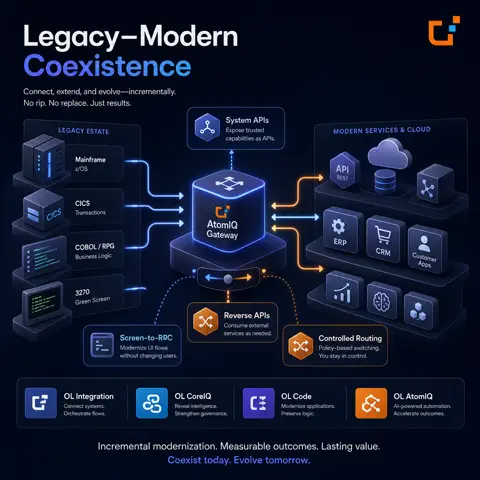
Legacy–Modern Coexistence
Run legacy and modern side by side with inbound System APIs, outbound Reverse APIs, change events, and gated decoupling routes.
Challenges
- Big-bang cutovers force a rewrite before modern channels can use host logic, while COBOL and RPG still cannot call modern HTTP services.
- Screen-bound programs are not service-shaped, so coexistence APIs cannot invoke the same rules without the green screen.
- Cross-app traffic during decoupling is implicit and irreversible, with no gated routing.
Benefits
- Expose existing CICS and connector operations as inbound System APIs and multi-technology endpoints without a cutover.
- Generate Reverse API COBOL/RPG clients and convert screen programs to RPC so host apps can call and be called as services.
- Apply AtomIQ modernization routing so cross-app dependencies are registered, approved, and reversible.
Run legacy and modern side by side: System APIs for inbound access to host logic and data, Reverse APIs so COBOL/RPG call modern HTTP services, screen-to-RPC for service-shaped programs, and AtomIQ gateway routing for incremental decoupling.
Products
- OL Integration: legacy connectors, contract-first APIs, multi-technology endpoints, and screens flow methods for modern consumption
- OL CoreIQ: System API bulk creation from CICS, VSAM dataset APIs, and VSAM change data capture
- OL Code: Reverse API clients, screen-to-RPC, and Hub asset testing
- OL AtomIQ: operations and domain discovery, data lineage, code-first screen flows to Hub, and modernization routing/gateway lifecycle
What it covers
- Operations, domain, and data-lineage discovery to choose coexistence boundaries
- Inbound System APIs over existing host programs, transactions, and datasets
- Outbound Reverse APIs from COBOL/RPG to modern HTTP
- Screen-to-RPC conversion for coexistence-friendly services
- VSAM change events to Kafka or webhooks so legacy and modern data stay in step
- Controlled cross-app routing during incremental decoupling