
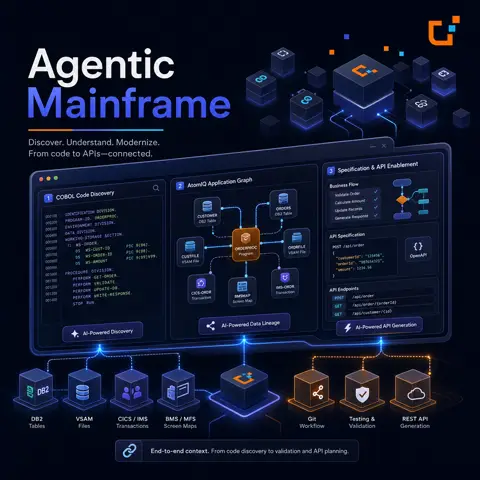
Agentic Mainframe
An agentic, context-aware workspace for z/OS mainframe teams to understand, change, document, and API-enable COBOL, CICS, IMS, DB2, and VSAM applications with AI grounded in the real code base.
Challenges
- Mainframe developers switch between ISPF green screens, DB2 and VSAM data tools, analysis workbenches, and separate documentation systems to understand a single COBOL program.
- Modernization teams lack trusted context about COBOL programs, copybooks, CICS and IMS transactions, data lineage, and business ownership as experienced mainframe staff retire.
- Specifications and API plans drift from the actual mainframe code base before stakeholders can validate how transactions really behave.
Benefits
- Developers inspect COBOL source, AtomIQ analysis, DB2 query results, VSAM records, and Hub service tests in one browser workflow instead of ISPF and separate tools.
- Architects use discovered operations, DB2/IMS/VSAM lineage, BMS and MFS maps, and the application graph to plan safer decomposition of the mainframe monolith.
- Teams generate, version, play (including 3270 mode), and scaffold specifications from real mainframe assets before committing to APIs or rewrites.
OL Code gives z/OS COBOL developers a browser-based workspace for understanding and changing mainframe applications in context. Legacy explorer and code editor replaces ISPF-style browsing with dataset and member navigation, editing, compile, JCL job submission, Ctrl+click navigation across programs and copybooks, and Git-oriented workflows. AtomIQ analysis beside the editor brings AtomIQ documentation, call relationships, and operations next to the open member. Developers can see the data a program actually touches through Read-only DB2 queries from the open file for embedded EXEC SQL and Read VSAM records from the open file for CICS file statements, create specifications from the open program with Run an OL Spec analysis from the open file, validate Hub assets through Hub asset testing from the IDE, let COBOL call modern REST APIs with Reverse API client generation, and refactor CICS screen-bound logic into callable services with Screen to RPC conversion.